

Why Your Lanzarote Insurance Claim Might Be Rejected
You have found a leak. You have called a plumber. You have the invoice. Now you submit your insurance claim and wait — only to receive a rejection letter telling you the evidence is insufficient.
This happens more often than most homeowners realise, and it is entirely avoidable. Insurance providers in Spain have tightened their requirements significantly over recent years. A plumber's receipt and a description of the problem are no longer enough to trigger a payout for Trace and Access work or structural repairs. What they want is a certified technical report, and there is a specific set of information it needs to contain.
We produce professional leak detection reports that are structured to meet insurer requirements. Here is what needs to be in yours.
The Five Things Insurers Look For
1. Evidence That Non-Invasive Methods Were Used
Insurance companies do not want to pay for unnecessary damage caused by guesswork. If your report cannot demonstrate that the leak was located using specialist technology — acoustic detection, tracer gas, or thermal imaging — the insurer may question whether the access work was justified. Your report should state clearly which methods were used and why.
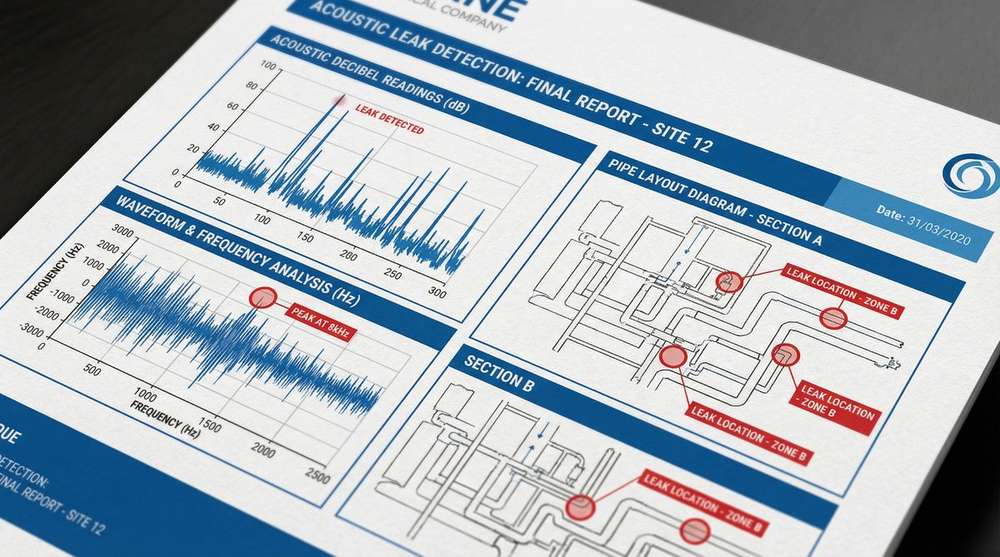
2. Quantified Technical Data
A written description of where the leak is does not carry the same weight as hard data. Acoustic surveys produce charts showing decibel readings at various points across the survey area, with a clear spike at the leak location. Gas tracer surveys produce concentration readings that pinpoint the fault. This data removes any ambiguity and gives the insurer something concrete to assess.
3. A Secondary Damage Assessment
The claim is rarely just about fixing the pipe. Insurers need to understand the wider impact: has the escaping water caused rising damp, undermined a foundation, or led to salt efflorescence on the walls? The report should document this clearly, because it directly affects the scope and value of the claim.
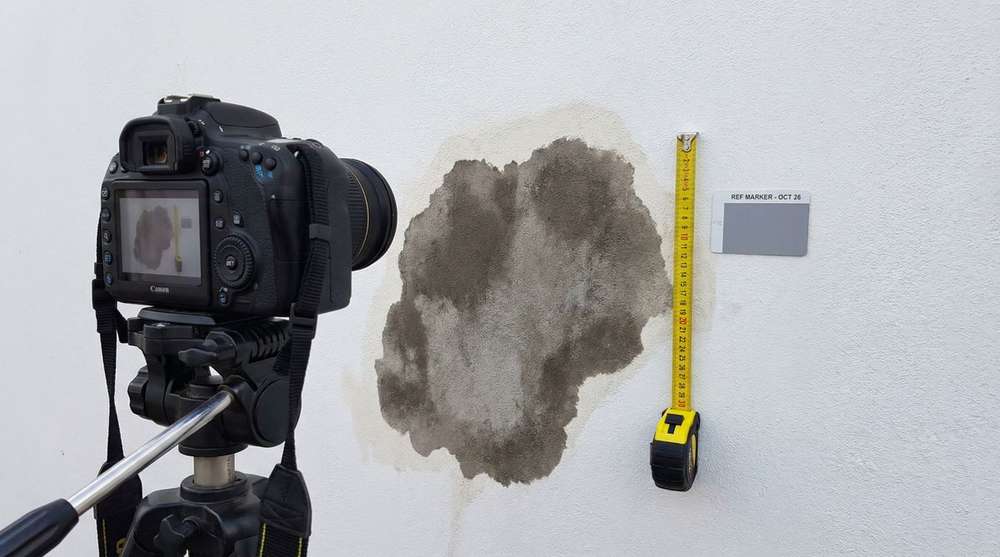
4. High-Quality Photographic and Visual Evidence
Written findings need to be supported by images. Thermal scans showing moisture patterns, photographs of the affected area with reference markers for scale, and CCTV footage of internal pipe conditions all strengthen the claim considerably. Without this, an adjuster has only your word for it.
5. A Precise Repair Recommendation
A good technical report does not just find the problem — it tells the repairer exactly where to go. When the leak location is pinpointed to within a few centimetres, the repair can be carried out surgically. That means less damage to floors and walls, which in turn reduces the overall cost of making good. Insurers respond well to this because it limits their exposure.
What Happens Without a Proper Report
The most common outcome is a partial payout or an outright rejection. The insurer may accept that a leak exists but dispute the extent of the damage, or argue that the access work was excessive because the location was not properly established before work began.
In some cases, homeowners end up paying for both the repair and the reinstatement out of their own pocket, when a proper survey report at the outset would have covered the full cost.
Start With a Free Leak Confirmation
Before you commission a full survey, we offer a free leak confirmation test. We check your water meter to establish whether there is active consumption when all outlets are closed. If the meter confirms a leak, we proceed to a full survey and produce the technical report your insurer needs.
The report is written in clear language, includes all the data and photographic evidence outlined above, and is formatted for use by your insurance company, solicitor, or loss adjuster.
Contact us today to arrange your free leak confirmation and get the evidence your claim depends on.